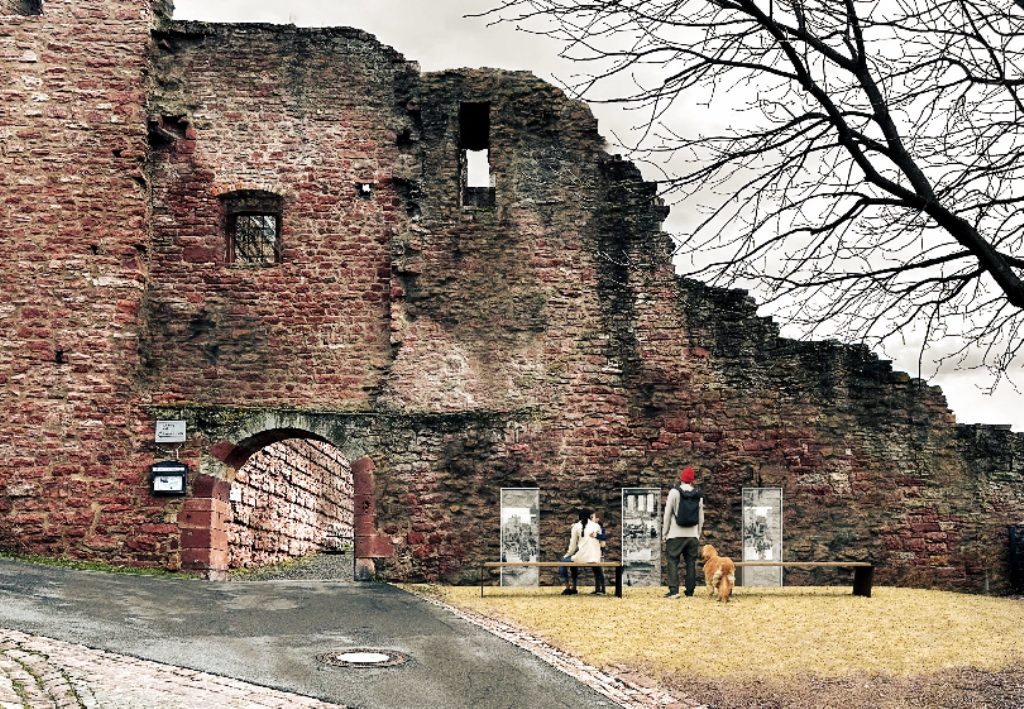
Visualization of the memorial site. Photo: City of Wertheim
April 1, 2025 marks the 80th anniversary of the end of the Second World War in Wertheim. To mark this date, a memorial and place of remembrance of the events of that time was established. The square below the castle at Hirschtor was upgraded with a modified surface, on which three steel-framed, 1.80-metre-high and 60-centimetre-wide text steles were erected.
The steles carry information about the events of April 1, 1945 in Wertheim. The corresponding texts were compiled by Dr. Monika Schaupp, Head of the Main-Tauber Archive Association, and Dr. Frank Kleinehagenbrock, Chairman of the Historical Association. The texts are based on scientific research.
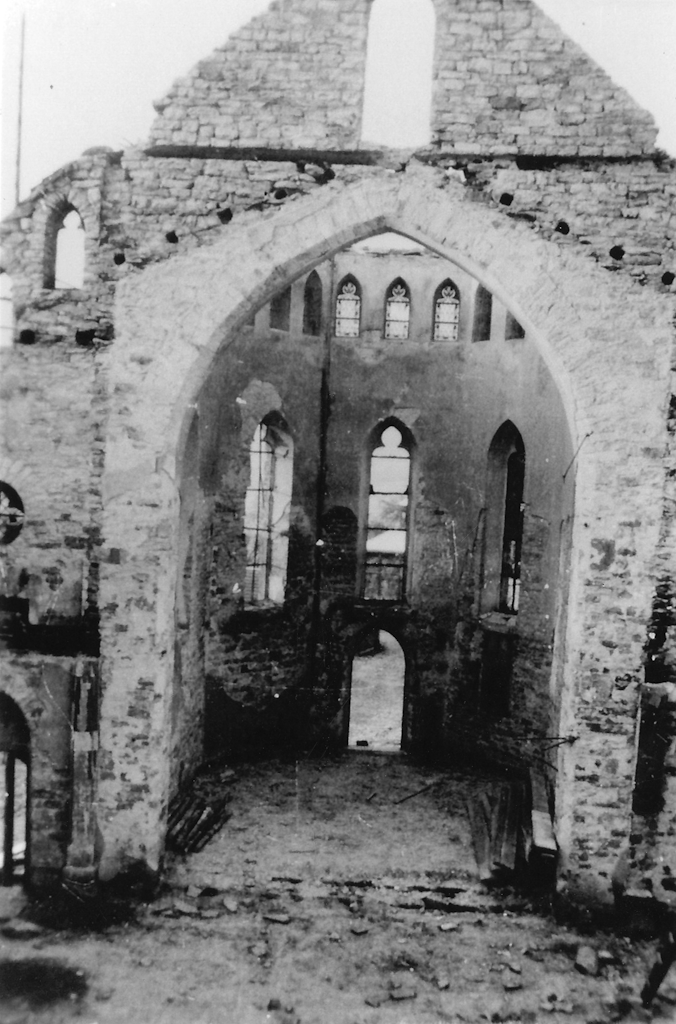
The destruction of Nassig on 30/31 March 1945
Church ruins in Nassig Photographer: Erwin Kaufmann
The crossing of the Rhine at Nierstein by the US Army on 22/23 March 1945 was inextricably connected with the collapse of the German front. The American troops were able to advance rapidly to the east. Just one week later, travelling across the Odenwald, they reached the area that is now the town of Wertheim. Bound by duty to the Nazi leadership and driven by Nazi propaganda, Wehrmacht units continued to fight despite a militarily hopeless situation. The consequences of this can be seen in the fate of the village of Nassig in the present-day town of Wertheim.
On Good Friday, 30 March 1945, a close combat group of the infantry reserve and training battalion from Ansbach (Middle Franconia) attacked an American tank approaching from the west in the direction of Wertheim. The group consisted mainly of 16- to 17-year-olds with no military training who had just a few days before been thrown into uniform.
The German soldiers made a last-ditch attempt to defend the village, despite knowledge of the fact that the Americans, in order to protect their soldiers, reacted harshly to acts of resistance. And they also knew about their practice of immediately stopping all combat when the white flag was raised.
The attack on the tank ultimately provoked the shelling of the village by the Americans. The bombardment finally came to an end on the afternoon of 31 March 1945.
In the shadow of the events, the parts of the Wehrmacht that remained in the region together with the Nazi district leadership gained the time they needed to retreat, and the airbase on the Wartberg was destroyed. The unnecessary combat that ensued shortly before the foreseeable end of the war had devastating consequences. Nassig was largely laid to ruin. The church, the school, 28 houses, 64 barns and other buildings were destroyed. Five members of the local population died. More than ten US GIs lost their lives in the fighting. 34 of the young local German soldiers were thrust into a hopeless battle and sacrificed as a result.
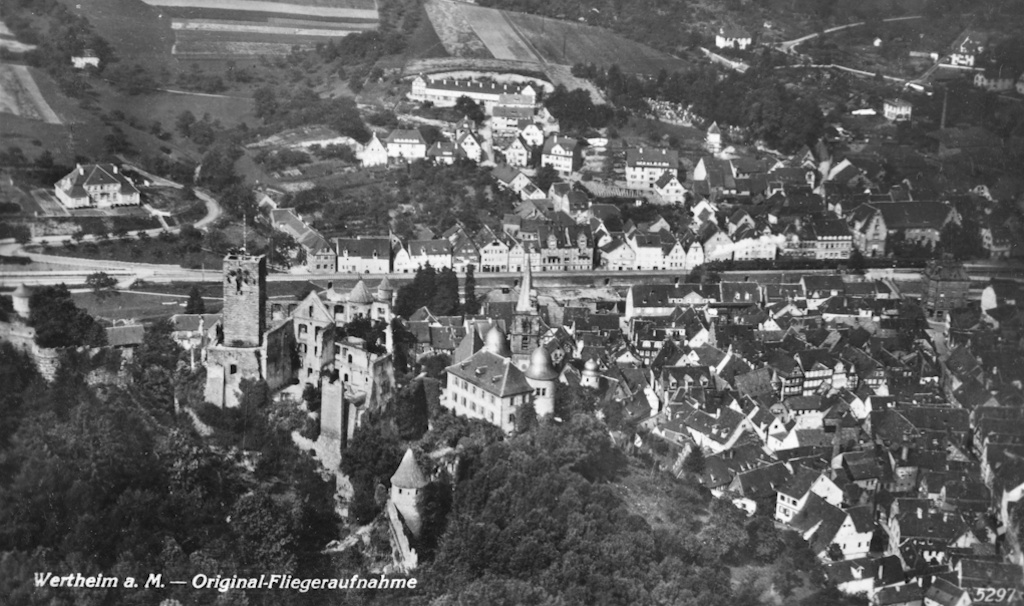
The rescue of Wertheim on 1 April 1945
View of the castle and across the Tauber towards Wartberg Original: StAWt S-N 70 No. 385, 6356/3,Photograph: Aero-Bild-Verlag Leipzig no. 5297, before 21.04.1941
The town of Wertheim remained for the most part intact and was peacefully handed over to the Americans on the afternoon of Easter Sunday, 1 April 1945 after raising white flags at the castle. However, it is unfortunately no longer possible to clarify the events in greater detail.
US soldiers had been standing on the Wartberg since the morning. From there they were able to look out over the town and the Main valley and watch the last German soldiers leave. The town was hit by sporadic shelling.
Wertheim was also to be defended. Aware of Nassig’s destruction, a number of men, most notably Anton Dinkel and Heinrich Herz, independently attempted to persuade the Nazi mayor Herrmann Dürr and the loyal local policeman Karl Mehling to peacefully surrender the town. Those whose names are also known include Christoph Dinkel, Josef Hammerich, Michael Kuch, Otto Paul, Karl Seher and Georg Staubitz. Through their actions, they defied the demands of the Nazi regime, thereby risking their lives. At the same time, the lives of the city’s inhabitants would have been put at risk in the event that hostilities had broken out. Most of them had taken refuge in cellars and the railway tunnel under the castle hill. A bombardment of the city by the US army in response to German defence measures would also have destroyed its economic livelihood.
The confrontation with the two Nazi officials was dramatic and lasted over an hour. Twice a white flag was hoisted on the castle, once it had to be taken down again, mainly due to pressure from the local policeman. After it was raised a second time – probably at around 4.45 pm –American soldiers marched into the city after 5 pm without incident and declared it captured at 9 pm. People were able to return to their homes on the evening of Easter Sunday.
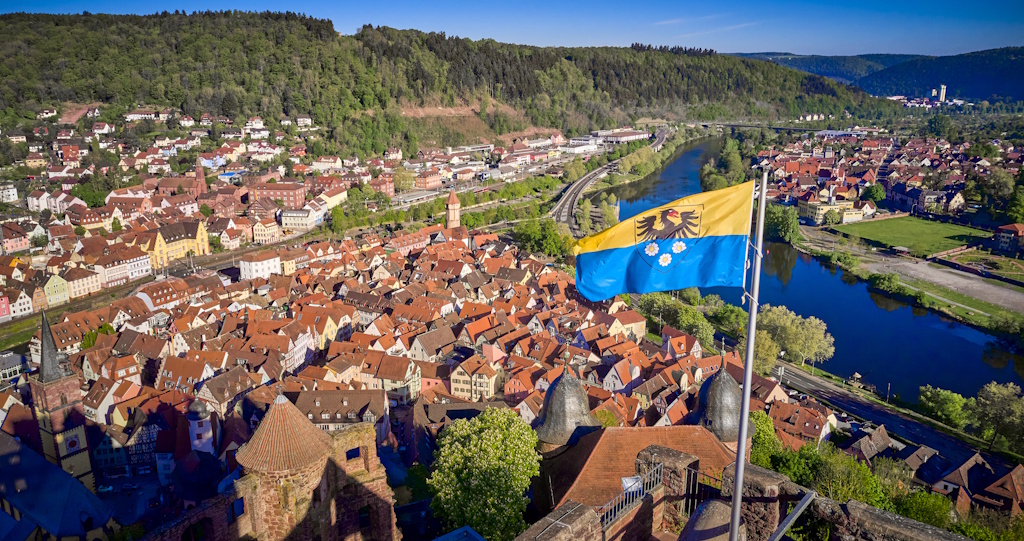
Wertheim after 1945
View of the old town from the castle towards Bestenheid Photographer: Peter Frischmuth, 2020
Due to the peaceful handover and occupation of the city by the US army, everyday life quickly returned to the undamaged city. After 1945, this also meant taking in numerous refugees and displaced persons. As a result, the number of inhabitants increased significantly in the following years. The majority of the inhabitants around 1970 were not born in Wertheim. The influx of people and companies, particularly in the glass sector, enabled the development of an industry. It first settled on the Wartberg, then mainly in Bestenheid, and opened up a future for the town that had been undreamt of before 1945.
The men who campaigned for the peaceful surrender of the city on 1 April 1945 showed great courage. Only one of them is known to have expressly distanced himself from the Nazi regime. They were united by their great regard for the city, their families and their businesses. This was perhaps accompanied by the realisation of the downfall of the Nazi regime, which was also made apparent by the withdrawal of German soldiers and the NSDAP district leadership.
Their actions teach us that it is important to show civil courage and to stand up for one’s fellow citizens. On Easter Sunday 1945, such a mission could have cost lives. Today we live in a democracy. Life in our city is shaped by the joint commitment of all its citizens towards freedom. The controversy surrounding the raising of the white flags at Wertheim Castle on 1 April 1945 reminds us that this can never be taken for granted.